A Path Born Between Worlds
The Sacred Call
Every spiritual tradition begins with a summons.
Sometimes it comes through inherited religion, family custom, or the faith of one’s childhood. Sometimes it arrives through books, rituals, dreams, or the unexpected voice of the soul. And sometimes it rises when every doorway offered by the world proves too narrow for the life trying to emerge.
Pink Faerie Way was born from that deeper call.
It did not begin as an institution or public movement. It began as longing. It began as the search for a path where femininity could be sacred, transformation could be honored, and identity could unfold without apology.
Early Roots in the Catholic Church
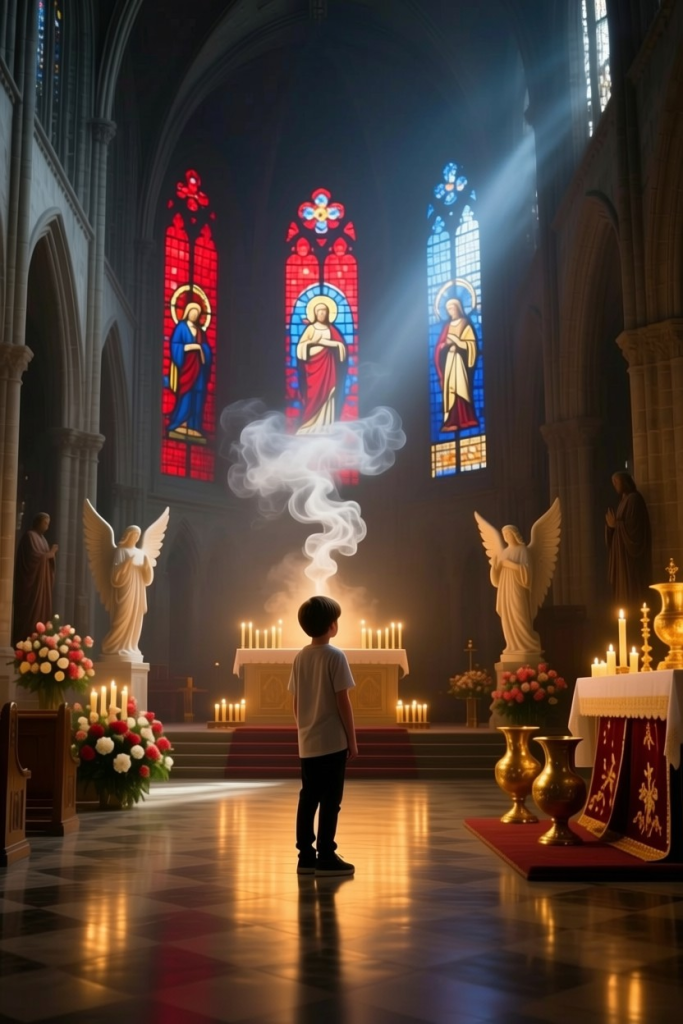
My earliest spiritual formation took place within the Catholic Church, and those early years left a lasting imprint upon my soul. Long before I understood where my spiritual path would eventually lead, I was shaped by the atmosphere of mystery, reverence, and sacred beauty that Catholicism could evoke. I entered spaces where candlelight flickered against stone walls, where colored light filtered through stained glass, where incense rose in curling clouds like visible prayer, and where silence itself seemed to carry meaning. There was a sense that one crossed a threshold when entering such places—that the ordinary world remained outside, while something deeper waited within.
I was drawn to the emotional and symbolic power of ritual. The lighting of candles, the ringing of bells, the rhythm of kneeling and standing, the recitation of ancient words, the solemn movement of processions, and the changing colors of the liturgical year all suggested that life could be infused with sacred pattern. Objects were not merely objects. Water could bless. Oil could consecrate. Bread and wine could become mystery. Images of saints, angels, and holy figures hinted that unseen realities stood close beside the visible world. Even as a younger seeker, I felt instinctively that symbols matter because they speak to parts of the soul language alone cannot reach.
The saints and sacred images especially stirred my imagination. Here were figures of devotion, courage, sacrifice, ecstasy, compassion, suffering, and transcendence. Their statues and paintings seemed to suggest that human life could become luminous, that flesh and spirit need not be enemies, and that beauty could serve as a doorway into contemplation. The Church, at its best moments, understood something profound: people do not live by doctrine alone. We also hunger for wonder, pageantry, fragrance, music, touch, and beauty.
Even then, I understood something important: beauty itself could be holy.
This lesson would remain with me for the rest of my life. Sacredness was not confined to abstract ideas or moral rules. It could be felt in candle flame, in song echoing through vaulted ceilings, in embroidered vestments, in polished metal, in flowers placed before an altar, in the solemn grace of ceremony. Beauty could soften the heart, awaken longing, and open the spirit to realities beyond the ordinary. It could make one feel, however briefly, that the world was charged with meaning.
Yet beauty alone was not enough.
As I grew older, deeper questions stirred beneath the surface of devotion. Questions of identity, femininity, embodiment, and becoming were already awakening within me, though I did not yet have language for all of them. There were truths forming quietly in the hidden chambers of the self—truths about who I was, how I longed to exist, and what kind of spiritual life might truly honor my soul. The outward forms around me offered certainty about many matters, but little refuge for these inner mysteries.
I began to feel a divide between the sacred presence I sensed and the structure through which it was presented. I did not lose my awareness that spirit was real. I did not lose my love of ritual, symbolism, reverence, or beauty. But I increasingly felt that the framework surrounding those treasures could not fully contain the life awakening within me. There was holiness there, yet not enough room for becoming. There was devotion there, yet not enough language for transformation. There was mystery there, yet not enough sanctuary for the truths I carried.
The sacred was real.
But the form through which it was offered no longer fit.
That realization was painful, but it was also the beginning of liberation. For when an old vessel can no longer hold the soul, the soul begins searching for a new one. In time, that search would lead me beyond inherited structures and into the creation of a path more spacious, more fluid, more enchanted, and more capable of honoring the sacred journey of becoming oneself.
The Path of the Seeker
So I became a seeker.
Many people know this stage of life: the season when one leaves familiar ground without knowing exactly where one is meant to arrive. It is both frightening and liberating. One walks by intuition more than map.
I stepped beyond the Church and wandered into other spiritual landscapes, searching for a path where mystery remained alive and where direct relationship with the sacred was welcomed.
That search led me to Wicca.
The Gift of Wicca
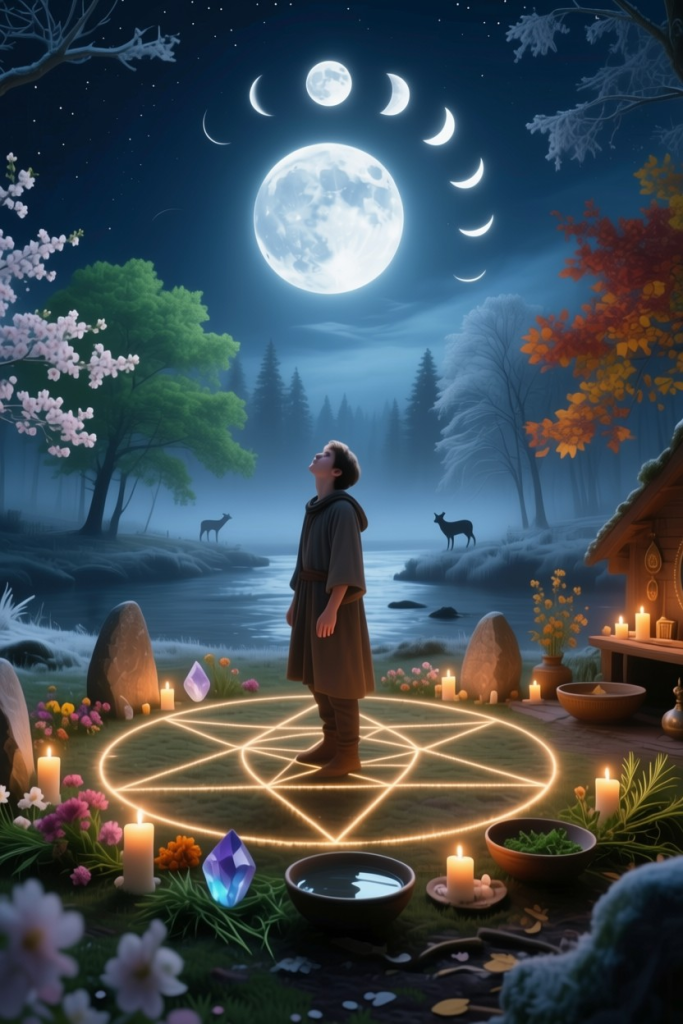
When I encountered Wicca, much of it nourished me deeply and opened doors within my spirit that had long been waiting to be unlocked. After experiences of religion shaped largely by hierarchy, fixed doctrine, and inherited authority, I found in Wicca a path that felt more intimate, participatory, and alive. Here were moon rites held beneath the night sky, seasonal celebrations that honored the turning wheel of the year, candle magic that transformed simple flame into sacred focus, circles cast in reverence, goddess devotion, and rituals that invited direct engagement rather than passive obedience. It felt like stepping into moonlight after a long enclosure, as though I had left a sealed chamber and entered a landscape where the sacred breathed freely.
I was especially moved by the honoring of the moon and her changing phases. The waxing moon, full moon, waning moon, and dark moon each carried their own mood, mystery, and spiritual lesson. Rather than seeing time as flat and mechanical, these practices taught me to recognize sacred rhythm in the unfolding of days and nights. The moon became a mirror of inner life, reflecting seasons of growth, fullness, release, rest, and renewal. Through lunar observance, I began to understand that change itself could be holy.
The celebration of the turning seasons also awakened something ancient within me. Spring, summer, autumn, and winter were no longer merely weather patterns or dates on a calendar, but living chapters in the spiritual story of the earth. Spring spoke of rebirth and desire, summer of abundance and radiant power, autumn of harvest and graceful letting go, and winter of stillness, protection, and hidden wisdom. To honor these seasons ritually was to remember that the soul, too, moves through cycles and that every stage of life carries its own gifts.
Another revelation was the practice of creating sacred space within the home. The altar, the candlelit corner, the table adorned with symbols of beauty and meaning—these taught me that holiness need not be confined to churches or distant sanctuaries. Spirit could be welcomed into everyday life. A room could become a temple. A candle could become prayer. A mirror, a flower, a crystal, or a bowl of water could become part of a living conversation with the unseen. This understanding would later become central to Pink Faerie Way.
Wicca also taught me to regard intention as a genuine force. Thought, desire, will, and focused emotion were not dismissed as private abstractions, but recognized as energies that shape experience. Ritual became the art of aligning inner purpose with outer action. Lighting a candle with intent, speaking words over an object, moving with symbolic purpose—these acts showed me that magic often begins where consciousness meets devotion.
Perhaps most importantly, I encountered a worldview in which the natural world was alive with spirit. Trees, rivers, moonlight, wind, stones, flowers, and animals were not merely background scenery for human life, but participants in a sacred cosmos. Nature was not empty matter. It was presence, mystery, and wisdom. This sense of enchantment stirred something profound in me and helped heal the divide many modern people feel between themselves and the living world.
These things spoke to my soul in lasting ways. They offered wonder where there had been dryness, participation where there had been distance, and sacred beauty where there had been confinement. Though Pink Faerie Way would eventually take its own distinct form, these gifts remained with me. The reverence for cycles, the honoring of beauty, the creation of sacred space, the power of intention, and the sense that spirit moves through the natural world still flow through the tradition today.
The Limits of Binary Spirituality
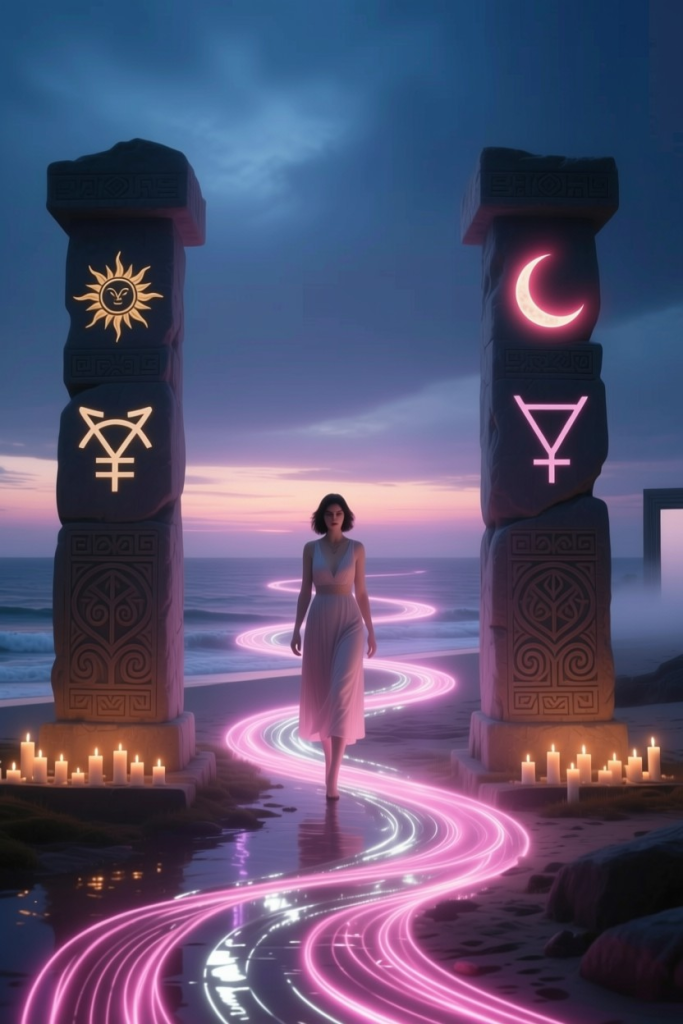
Yet over time, another truth revealed itself.
Many forms of Wicca were structured around strict polarity: masculine and feminine, God and Goddess, two complementary forces held as the cosmic foundation of spiritual life. For many practitioners, this symbolism was meaningful, beautiful, and genuinely useful. It offered a language of balance, relationship, and sacred interplay that resonated deeply with countless people.
But for me, it became increasingly limiting.
I began to notice that these systems often allowed movement only between two fixed poles while offering little room for the fuller complexity of lived human experience. They could acknowledge contrast and complement, yet often struggled to hold fluidity, transition, crossing identities, blended realities, multiplicity, and ways of being that existed outside inherited binaries. The language of sacred polarity could be poetic, yet it sometimes became too narrow when faced with lives shaped by transformation.
I was a transgender woman.
My life was not reducible to polarity.
My own experience had already taught me that identity can unfold in ways no rigid map predicts. The self may emerge gradually, through longing, courage, grief, revelation, and becoming. Femininity can be discovered, cultivated, embodied, reclaimed, and lived from within rather than assigned solely from without. It can be soft or fierce, radiant or quiet, sensual or wise, playful or solemn, and often many things at once. Human reality is richer than any simple formula.
I also came to understand that spirit itself moves through thresholds more often than it sits inside boxes. Dawn and dusk, tide and shore, birth and death, dream and waking, transformation and return—much of the sacred world lives in crossing places rather than fixed categories. Why, then, should human identity be any different?
The more I reflected, the more I realized that some systems had simply changed costumes while preserving older boundaries beneath new language. Though the symbols had shifted, certain limitations remained. I had left one framework seeking greater spiritual spaciousness, only to encounter another structure that still struggled to recognize the holiness of becoming.
This realization was not an act of bitterness, but of clarity. Wicca had given me genuine gifts, and I continue to honor what it offered. Yet I also knew that if I were to walk fully in truth, I would need a path expansive enough to embrace movement, mystery, and the sacred complexity of a life like mine.
The Decision to Build a New Path
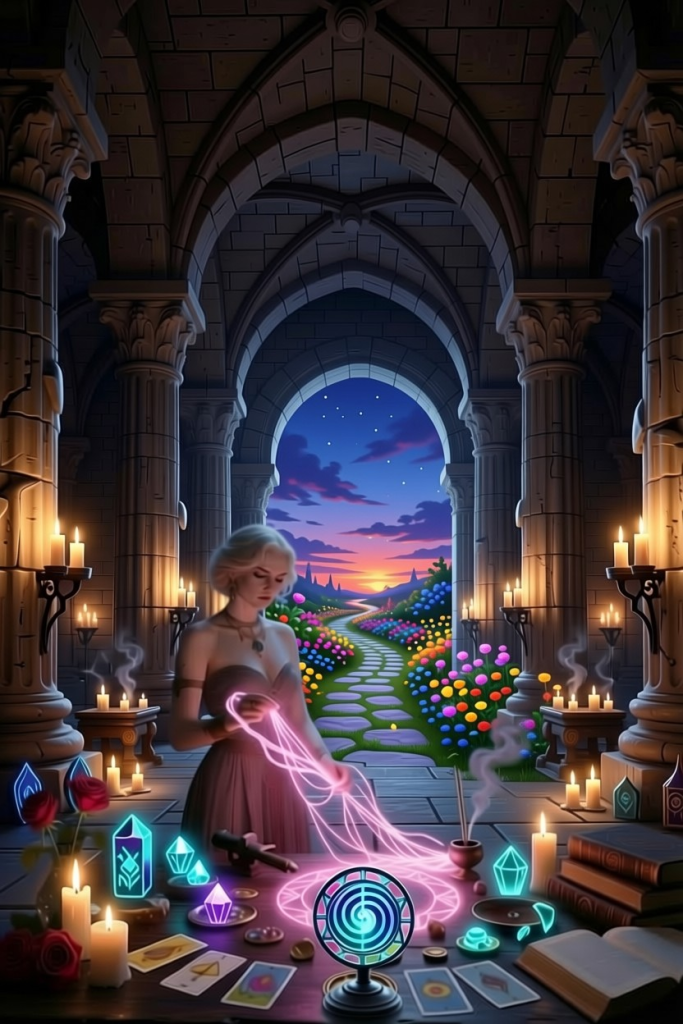
There comes a moment in many mystical journeys when one must ask a difficult and transformative question: if the path you need does not exist, will you remain spiritually homeless—or will you build one?
I chose to build.
Pink Faerie Way began quietly as a private spiritual current shaped for my own soul. It did not emerge all at once as a finished system, but unfolded gradually through reflection, practice, intuition, and lived experience. I gathered what was true and living from the traditions that had nourished me. I carried forward the power of ritual practice, the depth of sacred symbolism, the wisdom of moon cycles, the insight of tarot, the reverence for beauty, the devotion to feminine power, and the felt relationship with unseen spiritual realities. These were genuine treasures, and I saw no need to abandon what was life-giving simply because other parts no longer fit.
At the same time, I released what no longer served. I let go of rigid gender formulas that could not contain the complexity of becoming. I stepped away from exclusionary structures that offered spirituality with conditions attached. I abandoned forms of language too narrow to speak of transformation, fluidity, embodiment, and the truths awakening within me. I no longer wished to force myself into systems that required me to diminish who I was in order to belong.
What emerged was not a rejection of everything that came before, but an alchemical reworking of it. I took what nourished the spirit and left behind what constrained it. I allowed intuition, beauty, magic, femininity, and sacred change to gather into a new form—one capable of holding the life I was actually living rather than the life others expected me to live.
This was not rebellion for its own sake.
It was spiritual survival.
There are times when building a new path is not an act of pride, but an act of necessity. When inherited structures cannot hold the truth of the soul, one must either live divided or create something more spacious. Pink Faerie Way was born from the refusal to live divided. It became the sanctuary I needed, and in time, a sanctuary I hoped might serve others as well.
The Power of Liminality
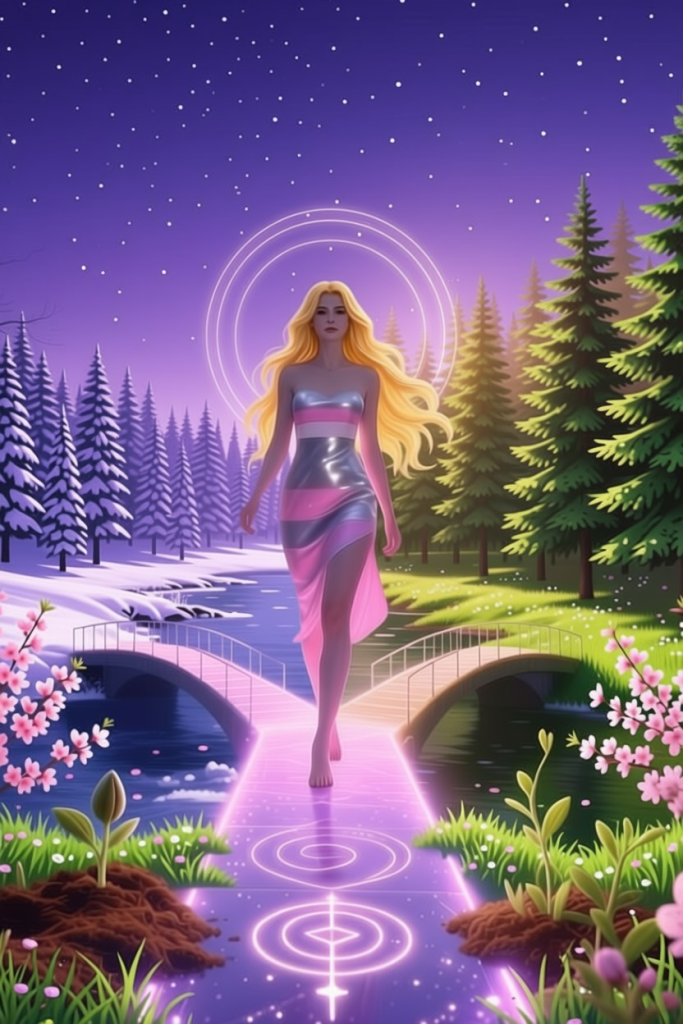
In place of rigid categories, I embraced liminality.
Liminality is the threshold realm, the mysterious space between what was and what is coming into being. It is the place between old and new, dusk and dawn, winter and spring, one self and another, concealment and revelation, grief and joy, departure and arrival. It is not a static place, but a living current of change. Thresholds often feel uncertain because they are unfinished, yet it is precisely within unfinished spaces that some of the deepest transformations of life occur.
Many spiritual traditions recognize the power of these in-between states. Ancient rites of passage, initiations, pilgrimages, fasting periods, retreats, mourning customs, and sacred vigils all place people within liminal time and space. The old identity loosens. The new identity has not fully arrived. One stands in mystery, vulnerable and powerful at once. The ego may experience such moments as disorientation, but the soul often experiences them as awakening.
Liminality became deeply meaningful to me because I came to understand that much of my own life had unfolded within thresholds. I knew what it meant to live between expectation and truth, between assigned identity and emerging reality, between the role the world assumed and the person quietly awakening beneath it. I knew what it meant to inhabit spaces others found difficult to categorize, even when those spaces were the very places where life and authenticity were flowering.
It is also the lived homeland of many transgender souls.
For many transgender people, transition is not simply a medical or social process. It is an initiation through layers of selfhood. It may involve loss and liberation, fear and courage, grief and ecstasy, endings and beginnings arriving at once. It asks a person to release inherited narratives and step toward truths that may have been hidden, denied, or impossible to name for years. It often means walking through uncertainty while carrying an inner certainty that others cannot yet see.
To exist in transition is not failure. It is initiation.
Our culture often misunderstands transitional states. It prefers fixed labels, immediate certainty, and identities that remain stable and easily explained. But life itself does not operate that way. Nature is full of metamorphosis. Caterpillars dissolve before becoming butterflies. Seeds split open before they bloom. Tides move in and out. The moon waxes and wanes. Dawn is neither night nor day, yet it is one of the most beautiful moments in existence.
So too with human becoming.
To stand between worlds is not confusion. It is sacred perspective.
Those who live within thresholds often see truths others miss. They understand that identity can be layered, that strength can coexist with softness, that endings can conceal beginnings, and that certainty is not the highest form of wisdom. People shaped by liminality frequently develop resilience, empathy, intuition, and the ability to imagine realities beyond inherited limits. They learn that there are more possibilities in life than the world first presents.
This insight became one of the spiritual foundations of Pink Faerie Way. Rather than treating in-between states as unfortunate or temporary inconveniences, the tradition honors them as places of power. The seeker between paths, the person healing after loss, the one discovering femininity, the soul rebuilding after shame, the lover awakening to desire, the practitioner stepping out of old identities—these are not broken states. They are sacred passages.
Pink Faerie Way teaches that thresholds deserve reverence. Moments of uncertainty can become ritual space. Times of becoming can become seasons of magic. The unfinished self is not lesser than the finished self, because there is no final form to the soul. Growth continues. Identity deepens. Beauty evolves. Wisdom unfolds.
Even the Faerie symbolism within the tradition arises from this truth. The Fae have long been associated with crossroads, twilight hours, hidden doors, forest edges, and places where one world touches another. They belong to the borderlands. They move freely where categories blur. They embody the enchantment found when boundaries soften and possibility widens.
Pink Faerie Way was built upon this truth: becoming is holy.
Not only arrival, but becoming. Not only certainty, but discovery. Not only identity declared, but identity unfolding through courage, tenderness, and transformation. The threshold is not merely something to pass through as quickly as possible. Sometimes it is where the deepest magic lives.
Finding the Faeries
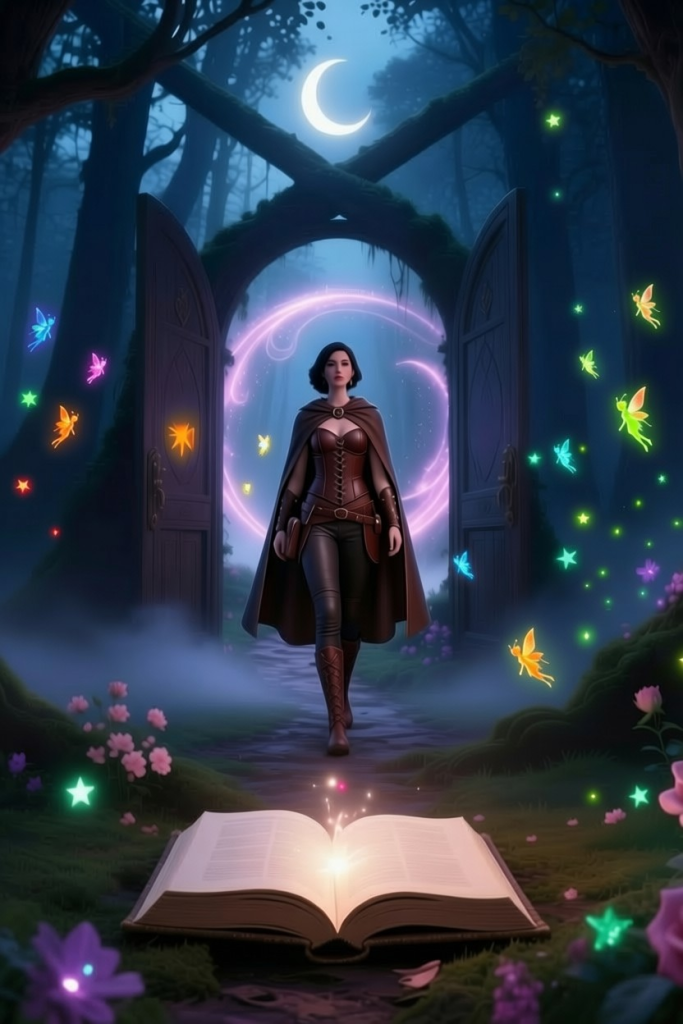
There, in that shimmering in-between realm, I found the Faeries.
They were not merely decorative figures of fantasy or harmless characters from children’s tales, but part of an older and deeper archetypal current. The Fae appeared to me as symbols of glamour, delight, sensuality, wisdom, danger, wildness, beauty, and metamorphosis. They represented forces that move just beyond the edges of ordinary life, drawing seekers toward mystery, transformation, and a more enchanted understanding of existence.
An important influence in this period of discovery was Witchcraft and the Gay Counterculture by Arthur Evans, which I encountered in the mid-1990s. That book opened a new doorway for me. It suggested that witchcraft, queer identity, resistance to oppressive systems, and sacred transformation could be woven together in ways rarely acknowledged by mainstream spirituality. Evans wrote of hidden histories, outsider wisdom, and magical traditions connected to those who lived beyond conventional social norms. Reading it stirred something deep within me. It helped me recognize that spiritual power often survives at the margins, carried by those whom society attempts to silence, erase, or exclude.
That inspiration led me to explore a wider range of Pagan and witchcraft literature. Among the works that shaped me were Be a Goddess! by Francesca De Grandis, Wicca: A Guide for the Solitary Practitioner by Scott Cunningham, and Faeriecraft by Alicen Geddes-Ward and Neil Geddes-Ward. I also read some material from the Feri Tradition, though it did not resonate with me in the same personal way. What did speak to me were paths that felt less constrained by rigid categories and more open to ecstatic experience, sensuality, personal gnosis, and sacred ambiguity.
Through these studies, I came to understand that mystery cannot always be systematized, and that transformation often requires stepping beyond the boundaries of ordinary thought. These influences deepened my appreciation for the magical significance of liminality, desire, beauty, and personal sovereignty—currents that would later help shape the foundations of Pink Faerie Way.
The Fae themselves seemed to belong to no tidy human system. They cross boundaries freely. They unsettle false certainty. They reward courage. They tempt seekers toward authenticity. They dwell in borderlands, crossroads, twilight places, and hidden doors. They invite those who encounter them into a reality where identity is fluid, joy is potent, and beauty carries power.
They felt like kin.
As a transgender woman and spiritual seeker, I recognized something familiar in their symbolism. The Faeries were beings of threshold and metamorphosis. They moved between worlds. They existed beyond simplistic binaries. They embraced glamour not as superficial display, but as transformative presence. They embodied the freedom to become rather than merely conform.
Thus the tradition became Faerie not because of fantasy, but because Faerie symbolism expressed truths I had lived. It spoke of crossing worlds and surviving thresholds. It reflected becoming through change rather than remaining fixed in expectation. It honored the joy that arises when one no longer waits for permission to exist fully.
The Faeries, in this sense, became spiritual companions of the path. They represented the courage to step beyond inherited limits, the wisdom hidden in outsider experience, and the sacred beauty of a self continually unfolding. Through them, Pink Faerie Way found one of its clearest languages: enchantment as liberation, transformation as destiny, and joy as a form of magic.
Why Pink?
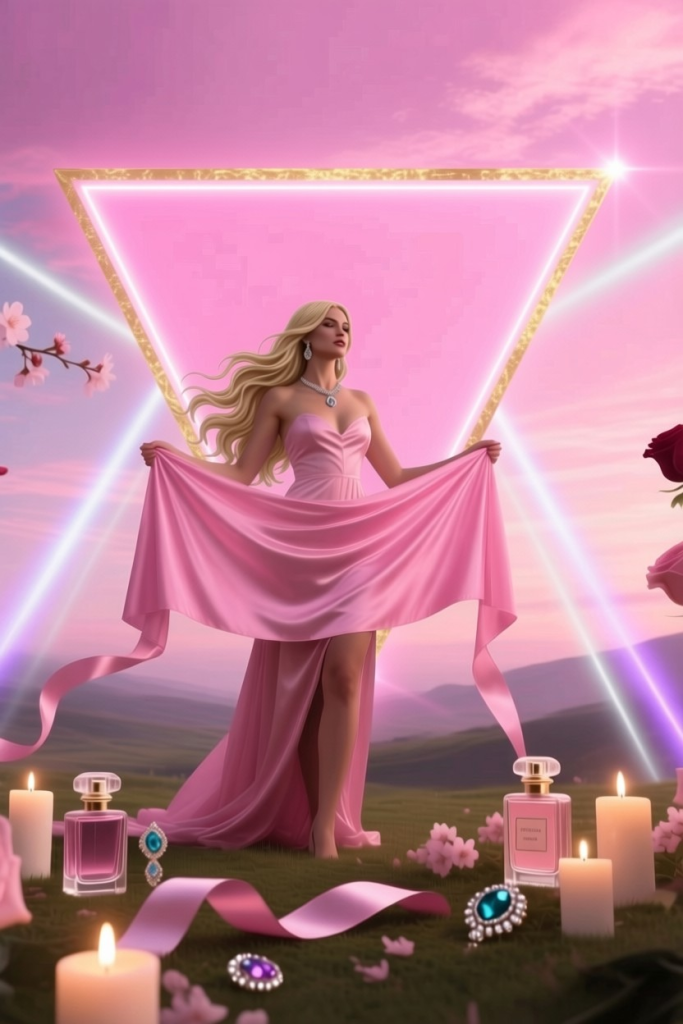
Then came the name.
I chose pink with deep intention, because colors carry meaning, memory, and emotional power. Pink was never, to me, a shallow or accidental choice. It held layers of symbolism that spoke directly to the spirit of the tradition and to my own life experience.
Pink has long been associated with femininity, softness, sensuality, tenderness, beauty, adornment, blossoms, sweetness, and playful radiance. Yet many of these qualities have often been dismissed by the wider culture as trivial, weak, frivolous, or unserious precisely because they are linked to femininity. I wanted to challenge that dismissal and reclaim what had been diminished. I wanted to affirm that softness can be strength, elegance can be power, glamour can be sacred, and feminine beauty need not apologize for existing.
To choose pink was therefore an act of spiritual reversal. It was a way of honoring forms of power that patriarchal culture frequently overlooks. There is courage in tenderness. There is resilience in softness. There is transformative force in beauty freely embraced. Pink became a declaration that what is often mocked may in fact contain hidden sacredness.
But pink carried another meaning as well—one rooted in pain, memory, and queer resistance.
The Pink Triangle was used by the Nazis to identify and persecute gay men in concentration camps. What was meant as a mark of shame and dehumanization was later reclaimed by LGBTQ+ communities as a symbol of remembrance, defiance, survival, activism, and pride. A sign once imposed through hatred was transformed into one of dignity and solidarity.
That symbolism moved me deeply.
As a queer and transgender person, I understood the spiritual power of reclamation. Many of us inherit labels meant to diminish us, narratives meant to erase us, and judgments meant to wound us. To take what was once used against us and transmute it into strength is a profoundly magical act. It is alchemy of the soul.
Pink, then, became doubly sacred to me. It was femininity reclaimed from mockery and queer resilience reclaimed from persecution. It was tenderness sharpened into courage, beauty carrying memory, and joy refusing to forget the struggles that made such joy possible.
Thus Pink Faerie Way became more than a name.
It became a banner.
It became a color of transformation, resistance, pleasure, memory, sacred femininity, and the radiant refusal to be diminished.
The Arrival of the Pink Faerie Queen
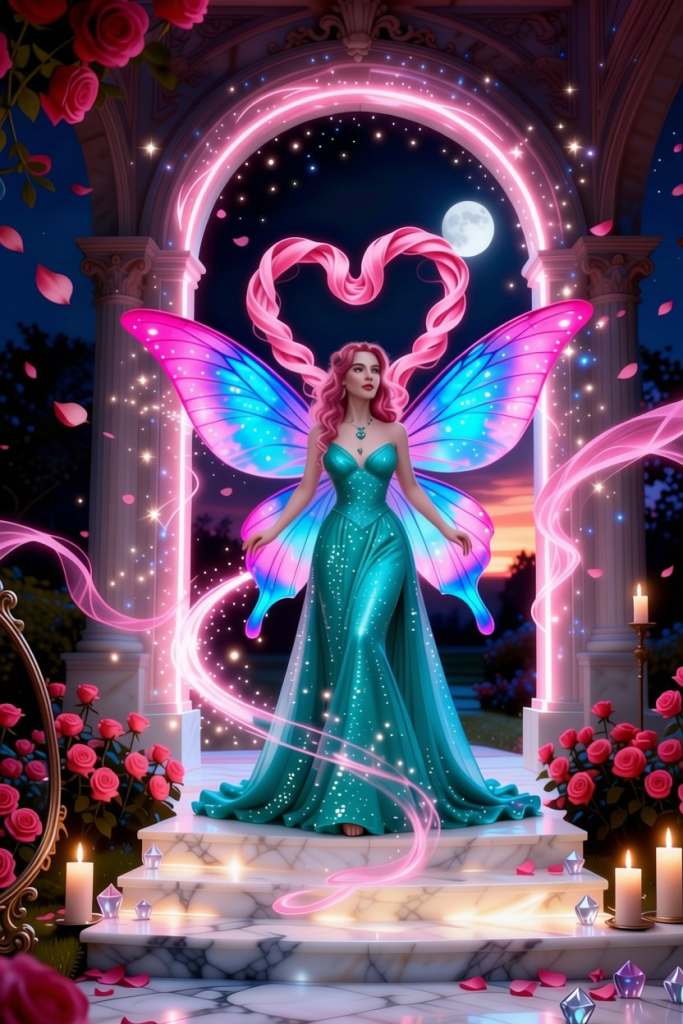
As the tradition deepened, another presence emerged: the Pink Faerie Queen.
She did not arrive as dogma, commandment, or rigid theological figure. She came first as symbol, then as archetype, and eventually as a living guide within my spiritual imagination. She arose naturally from the inner current of the path itself, as though the tradition had been speaking through image before it could fully speak through language. Long before I could explain every principle of Pink Faerie Way, I could feel her presence as the embodiment of what the tradition was becoming.
She carried radiant femininity without apology. In her there was no need to justify beauty, softness, elegance, sensuality, or feminine power. She existed in complete self-possession, untouched by the shame and diminishment so often imposed upon femininity by the wider world. She represented a form of womanhood that did not ask permission to exist.
She also embodied sovereignty without domination. Her power was not rooted in control, cruelty, fear, or hierarchy. She ruled through presence rather than force, magnetism rather than coercion, wisdom rather than violence. She reflected a kind of authority often missing in worldly systems: power that uplifts rather than crushes, guides rather than subjugates, protects rather than exploits.
There was sensuality within her, but sensuality without shame. She revealed that pleasure, beauty, desire, adornment, and embodiment need not be hidden or treated as lesser things. In her image, the body was not an obstacle to spirit, but one of its sacred instruments. She taught that joy in the senses can coexist with depth, devotion, and spiritual truth.
She expressed glamour not as deception, but as revelation. True glamour, in the sense I came to understand it, is not the hiding of the self but the intentional unveiling of inner radiance. Through beauty, confidence, style, movement, and presence, one may reveal truths that ordinary language cannot convey. The Pink Faerie Queen showed me that adornment can be magical when it reflects authenticity.
Yet she was never merely softness or splendor. She held tenderness fused with resilience. She knew sorrow, exile, rejection, and the wounds of those who had been made to feel outside the circle. But she transformed those wounds into compassion rather than bitterness. She represented the strength that emerges when one survives and still chooses beauty, kindness, and joy.
Above all, she embodied joy after exile. She was the one who had passed through darkness and emerged luminous. She had crossed the threshold already and now stood there waiting, not to judge, but to welcome others through. For anyone who had felt spiritually displaced, shamed, unseen, or cut off from sacred belonging, her presence carried a profound message: there is still a place for you in the enchanted world.
The Pink Faerie Queen became, for me, more than an image. She was muse, guardian, mirror, and invitation. She represented the liberated self many seek but struggle to imagine. Through her, the path gained a face, a voice, and a heart. She made visible the truths Pink Faerie Way wished to teach: that femininity can be sovereign, pleasure can be sacred, glamour can be truthful, and those once cast out may return crowned in light.
How the Pink Faerie Queen Guided Me
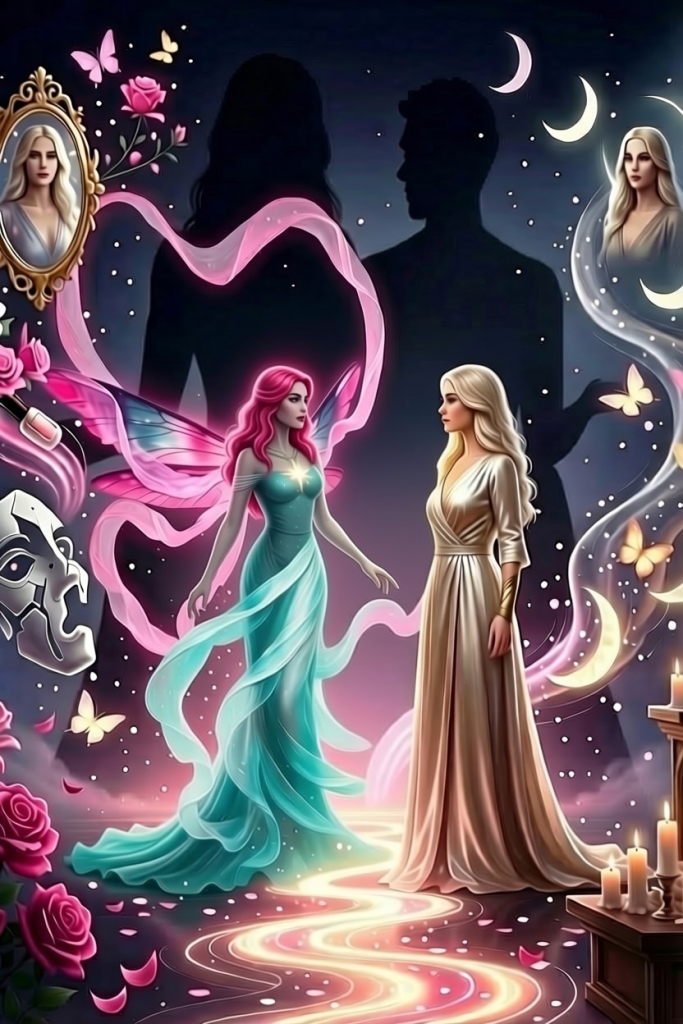
Over time, the Pink Faerie Queen became my guide.
She did not guide me through commandments or rigid doctrines, but through presence, symbolism, intuition, and the quiet wisdom that rises through spiritual imagination. Her influence was subtle yet profound, arriving in moments when I most needed clarity, courage, or remembrance. She became a living expression of the truths I was still learning to trust within myself.
When I struggled with self-doubt, she reminded me that beauty is not vanity when it arises from truth. She taught me that there is nothing shallow about honoring one’s body, adorning oneself with intention, or cultivating radiance born from self-respect. Beauty, in this sense, was not performance for others but devotion to the self.
When I feared judgment, she taught me that authenticity shines brighter than approval. The opinions of those committed to misunderstanding could never equal the peace found in living honestly. She showed me that the self becomes luminous when it no longer bends itself into shapes designed only to satisfy others.
When old shame returned, she revealed that the body can become sacred ground. So many are taught to carry conflict, embarrassment, or estrangement within their own flesh. She helped me understand that the body may instead become altar, vessel, companion, and site of healing. Through her guidance, embodiment itself became spiritual practice.
When I felt alone, she stood as proof that spiritual femininity need not ask permission from any institution. No church, temple, tradition, or authority could grant or deny the reality of inner truth. She represented a femininity that was sovereign, self-existing, and radiant in its own right.
When I hesitated before change, she whispered that metamorphosis is the oldest magic. Nature itself transforms endlessly—seasons turn, moons shift, flowers bloom and fade, creatures shed old forms and emerge renewed. Why should the soul be any different? Through her, I came to see change not as danger, but as sacred movement.
She became many things to me over the years. She was muse, inspiring beauty, creativity, and spiritual vision. She was guardian, offering strength and protection in times of vulnerability. She was mirror, reflecting possibilities within myself I had not yet fully claimed. She was initiatrix, leading me through thresholds of growth and awakening. She was patron presence, a luminous figure through whom the spirit of the tradition could be felt and known.
For me, she was real in the way many guides are real.
She changed me.
Whether understood as archetype, spiritual presence, sacred symbol, or inner wisdom clothed in radiant form, her reality was measured not by argument but by transformation. She helped me become more whole, more courageous, more tender, more joyful, and more fully myself. In that sense, her guidance was undeniable.
The Practices That Grew From the Tradition
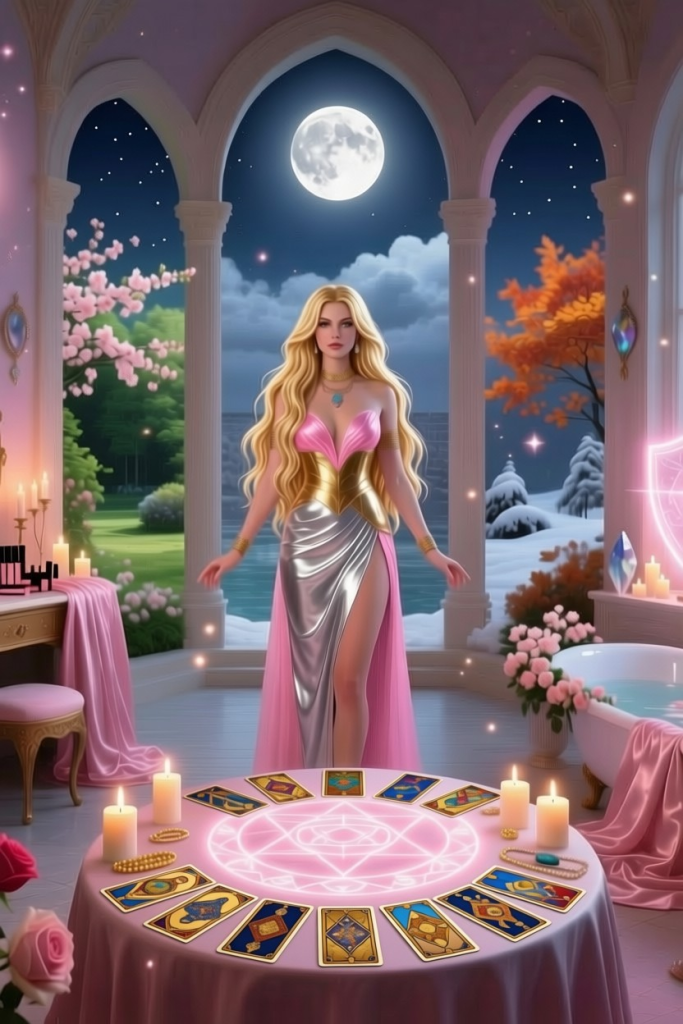
As Pink Faerie Way matured, practical forms of devotion naturally emerged. These practices were not created as rigid obligations, but as living ways to embody the values of the tradition in everyday life. They became methods through which beauty, healing, transformation, and sacred power could be experienced directly. Over time, several core devotions took shape, each offering a different doorway into the path.
Glamour Workings
Glamour workings arose as one of the most distinctive practices of the tradition. In Pink Faerie Way, glamour is not deception or vanity, but the sacred art of revealing inner radiance through intentional self-presentation. Clothing, cosmetics, jewelry, fragrance, hairstyle, posture, movement, and adornment may all become instruments of magic when approached with consciousness and purpose. To prepare oneself with care can become a ritual of confidence, self-love, and embodiment. Glamour workings teach that beauty can be a form of power when it is self-owned, and that the body may become a living altar through which presence, dignity, sensuality, and truth are expressed.
Tarot as Transformation
Tarot became a central devotional practice because it speaks in the language of symbols, cycles, and hidden truths. Within the tradition, tarot is more than divination; it is a mirror of becoming. The cards offer insight during times of confusion, comfort during sorrow, and guidance during periods of change. They reveal patterns beneath the surface of daily life and invite deeper trust in intuition. Certain cards may come to represent healing, rebirth, courage, love, endings, or new beginnings. Through regular practice, tarot becomes a sacred companion on the path, helping practitioners understand themselves more clearly and navigate transformation with wisdom.
Moon & Seasonal Cycles
The honoring of moon phases and seasonal cycles became another natural devotion within Pink Faerie Way. The waxing moon, fullness, waning moon, dark moon, and the turning of the seasons all reflect the rhythms of life itself. There are times for growth, times for abundance, times for release, times for rest, and times for renewal. By observing these cycles, practitioners learn to move with life rather than against it. Full moons may inspire glamour, celebration, and manifestation, while waning moons may support healing and letting go. Spring may awaken desire and beginnings, autumn may invite gratitude and maturity, and winter may call for retreat and restoration. In honoring nature’s rhythms, one also learns to honor the rhythms of the soul.
Sacred Sexuality
Sacred sexuality emerged as a devotion rooted in healing the false divide between body and spirit. The tradition teaches that pleasure, desire, sensuality, affection, and erotic energy need not be treated as shameful or spiritually inferior. When grounded in consent, honesty, respect, and self-awareness, these experiences may become expressions of sacred life force. For many practitioners, this devotion includes reclaiming bodily dignity after years of shame, invisibility, or rejection. It may take the form of self-love rituals, sensual meditation, partnered intimacy, or simply learning to inhabit the body with gratitude and joy. Sacred sexuality affirms that embodiment itself can be holy.
Protection & Resilience
Protection and resilience developed as essential devotions because no spiritual path exists outside the realities of hardship, cruelty, exhaustion, or emotional struggle. In Pink Faerie Way, protection is not rooted in fear, but in self-respect and wise care of one’s energy, boundaries, and wellbeing. Cleansing rites, affirmations, grounding practices, protective symbols, prayer, and the blessing of one’s home may all serve this purpose. Resilience is the deeper art of recovering after pain and refusing to let suffering define the spirit. It is the strength to remain radiant after difficulty, to choose healing after harm, and to continue becoming despite adversity. Through these practices, the practitioner learns that inner light can endure even through storms.
Why I Chose to Share It
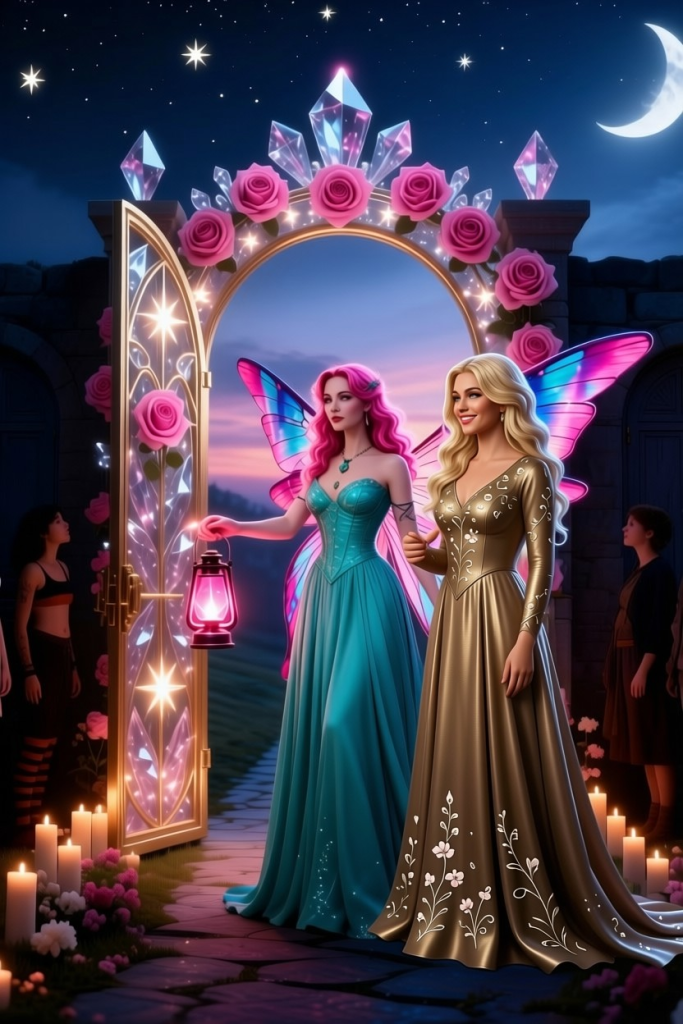
So after thirty years, I chose to share Pink Faerie Way.
I did not share it because I claim universal truth, nor because I believe one path can meet the needs of every soul. I did not create it in order to replace anyone else’s tradition or to declare that all seekers must walk the same road. The world holds many sacred paths, and each person must discern what speaks most deeply to their own spirit.
I chose to share Pink Faerie Way for a more personal reason.
I know what it is to stand between worlds, sensing that the sacred is real while feeling unable to find oneself reflected in the forms through which it is offered. I know what it is to hunger for spirituality while carrying truths that many traditions do not know how to hold. I know what it is to long for beauty, mystery, ritual, and belonging while standing at the threshold of spaces that never fully open.
Because I know that feeling, I knew others must know it as well.
I shared this path because another transgender woman may need to hear that her becoming is holy. She may need to know that transformation is not failure, confusion, or deviation, but sacred unfolding. She may need a language of spirituality that recognizes femininity discovered from within as real, powerful, and worthy of reverence.
I shared it because another queer seeker may need beauty after years of condemnation. Many people have been taught that their desire, identity, tenderness, or joy places them outside grace. I wanted to offer a path that says the opposite—that pleasure can be sacred, beauty can heal, and joy can be an act of spiritual restoration.
I shared it because another soul may need a guide waiting at the threshold. Sometimes what helps us most is not certainty, but welcome. Not doctrine, but a doorway. Not judgment, but the knowledge that someone has crossed this terrain before us and left light behind.
Pink Faerie Way is new in form, but ancient in hunger.
Human beings have always sought transformation. They have always turned to symbols when ordinary language failed them. They have always healed through ritual, loved ecstatically, searched for meaning in moonlight and flame, and remade themselves after suffering. The desire for rebirth, enchantment, beauty, and sacred belonging is older than any modern system.
What is new is not the need.
What is new is the language.
What is new is the banner of pink flame carried into this age—a language of femininity reclaimed, queer resilience honored, transformation celebrated, and spiritual power made radiant through tenderness rather than domination.
If I were to name the deepest origin of Pink Faerie Way, I would say this:
It began the moment I realized that no inherited doorway could hold the fullness of what I was becoming. It began when I understood that waiting forever for permission is its own kind of exile. It began when I stepped into twilight carrying candles, moonlight, memory, queer resilience, and sacred desire.
There, in that threshold place, the Pink Faerie Queen met me.
Together, we built a gate of roses and starlight.
Then we left it open for others.