
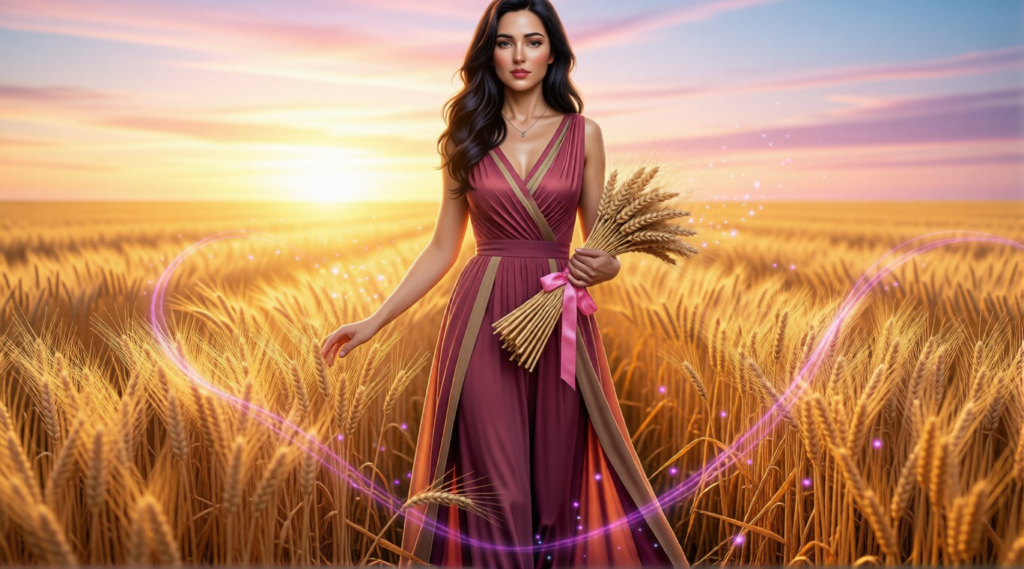
September has always felt like a month caught between worlds. Summer has not completely released its hold, yet autumn has begun making itself known. The evenings arrive a little earlier. The sunlight falls differently through the trees. Leaves begin hinting at the colors they will soon become. Gardens that spent the summer growing now offer up what they have produced.
It is a season of thresholds, but it is also a season of harvest.
When we hear the word harvest, it is easy to think of fields of wheat, baskets of apples, pumpkins, and the abundance of the earth. Within Pagan traditions, the harvest season carries particular spiritual significance. We recognize the relationship between what was planted, what was nurtured, and what has finally grown.
But lately, I have been thinking about another kind of harvest.
What have I grown within myself?
So much of life is spent planting. We make decisions without knowing where they will lead. We begin relationships. We leave others behind. We pursue dreams. We change careers. We write books. We discover new communities. We take frightening first steps toward becoming the people we believe ourselves to be.
Then we keep moving.
We don’t always stop long enough to notice what grew.
I think about this often when I consider my life as a transgender woman. Transition is frequently described through beginnings. There is the moment of realization, coming out, choosing a name, beginning hormones, changing how we present ourselves, and all those wonderful and terrifying firsts.
Those moments deserve to be celebrated.
But there is another part of transition that receives much less attention: what happens when years have passed.
At some point, the seeds become a garden.
I can look backward now and see a woman my younger self could not have fully imagined. Not a perfect woman. Not a finished woman. As I wrote recently, I no longer believe there is some final version of myself waiting at the end of the path.
But I can still recognize what has grown along the way.
I have harvested confidence that once seemed impossible.
I have harvested a relationship with my femininity that belongs to me rather than to someone else’s expectations of womanhood.
I have harvested a sexuality no longer defined by the shame I learned growing up.
I have harvested the freedom to look at my body with greater tenderness.
I have harvested words, stories, relationships, memories, and experiences.
And I have harvested a spirituality that finally feels like my own.
That last harvest is particularly meaningful to me.
I grew up with religious ritual, but also with religious rules that left little room for someone like me. Later, Humanism gave me a way to understand ethics and meaning without needing supernatural certainty. Unitarian Universalism gave me a spiritual community where different paths could sit beside one another. Faerie Wicca eventually gave me something I had been missing: a way to bring ritual, sensuality, nature, transformation, and wonder back into my life.
None of those experiences disappeared when I moved into the next chapter. Each planted something.
My spiritual life today is partly the harvest of all those earlier selves.
That realization has helped me become gentler toward the person I used to be.
It is tempting to look backward and judge ourselves with knowledge we possess only because we lived through those earlier years. Why didn’t I understand myself sooner? Why did I believe certain things? Why didn’t I make a different choice?
But seeds do not become flowers because we yell at them for taking too long.
They grow when the conditions allow them to grow.
So did I.
The harvest metaphor also reminds me of something less comfortable: not everything we plant flourishes.
Some dreams fail.
Some relationships end.
Some plans never become what we hoped they would become.
Sometimes we spend years nurturing something only to discover that it cannot grow in the soil where we planted it.
There is grief in every harvest season. The abundance of autumn exists alongside decay. Leaves become magnificent precisely as they approach the moment of falling.
Faerie spirituality does not require me to pretend otherwise.
Nature is beautiful because it contains beginnings and endings simultaneously. Growth and loss belong to the same landscape. The challenge is learning to recognize what an experience gave us without pretending that everything happens for some predetermined reason.
I don’t believe every painful experience was secretly a gift.
But I do believe I can decide what I carry away from it.
Perhaps that, too, is a kind of harvesting.
As the autumn equinox approaches and daylight and darkness move toward balance, September offers us an opportunity to stop. Not forever. Just long enough to look at the field behind us.
What grew this year?
What grew over the last ten years?
What grew from a decision you once made while terrified?
What part of yourself exists today because an earlier version of you dared to plant something?
And what are you finally ready to gather?
Your harvest doesn’t have to impress anyone. Maybe you learned to establish a boundary. Maybe you survived something difficult. Maybe you rediscovered pleasure. Maybe you created something. Maybe you allowed yourself to be loved. Maybe you finally said your own name without fear.
Perhaps you simply became a little kinder toward yourself.
Gather that.
Honor it.
In my own practice, I like the idea of making this reflection tangible. Write down several things you have cultivated within yourself. Place the paper on your altar beside something associated with autumn—an apple, fallen leaves, flowers, seeds, or a candle. Sit quietly with what you have written.
Don’t immediately ask what comes next.
That is difficult for many of us. We are accustomed to turning every accomplishment into another beginning. We reach one milestone and immediately ask where the next one is.
The harvest teaches another rhythm.
There is a time to plant.
There is a time to grow.
And there is a time simply to receive.
So this September, I am trying to look at my life without immediately asking what I still need to become. I want to recognize the woman who is already here and everything she has gathered along the way.
There will be more seeds.
There will be more thresholds.
There will be more becoming.
But today, I want to stand for a moment in the garden I have already grown.
And I want to be grateful for the harvest.