There are certain Tarot cards that can change the mood of a reading the moment they appear.
Death.
The Devil.
The Tower.
The Moon.
Even people who know very little about Tarot recognize some of these images. Popular culture has taught us what we are supposed to think when we see them. Death means someone is going to die. The Devil means evil. The Tower means catastrophe. The Moon means something sinister is lurking in the darkness.
But Tarot is rarely that simple.
I have come to believe that some of the cards we fear most can also be among the most valuable cards in the deck. They do not necessarily tell us that something terrible is coming. Instead, they ask uncomfortable questions. They invite us to look at transformation, desire, uncertainty, destruction, and the parts of ourselves we might prefer to leave unexplored.
Perhaps that is why they frighten us.
Not because they predict monsters.
Because sometimes they hold up mirrors.
October feels like an appropriate time to spend some time with these cards. The days are growing shorter. Darkness arrives earlier. Halloween and Samhain surround us with images of death, ghosts, shadows, and things hidden beyond the ordinary world.
Yet darkness does not have to mean evil.
Within the Pink Faerie Way, I find darkness particularly interesting because it creates a different kind of space. Daylight reveals. Darkness obscures. When we cannot see everything clearly, we have to become comfortable with mystery.
And transformation often begins in places where we cannot yet see what we are becoming.
Death may be the most famously misunderstood card in Tarot.
Its imagery can certainly be unsettling. Yet I rarely think of Death as a prediction of literal death. I see it much more often as the recognition that something has reached its ending.
That can still be frightening.
We become attached to identities, relationships, beliefs, expectations, and versions of ourselves. Even when something no longer serves us, familiarity can feel safer than change.
Death asks a difficult question:
What has already ended that you are still trying to keep alive?
There have been many deaths in my own life that did not involve dying.
There were identities I once believed described me that eventually stopped fitting. There were beliefs I once accepted that I could no longer carry. There were expectations about gender, sexuality, religion, and the kind of life I was supposed to live.
Letting those things go did not erase the person I had been.
They created space for someone else to emerge.
That is why I find Death strangely beautiful. It reminds me that endings are not failures. Sometimes an ending is simply the moment when transformation becomes unavoidable.
Then there is The Devil.
Of all the cards in the Tarot, this may be one of the easiest to misunderstand, especially for those of us who grew up within religious traditions where the Devil represented absolute evil.
But when I encounter The Devil in Tarot, I am much more interested in chains than horns.
What binds us?
And perhaps more importantly, who taught us that we were supposed to be bound?
For me, this card inevitably touches sexuality.
I grew up being taught that certain desires were sinful. Before I understood myself as a woman, I understood myself as a feminine gay man, and the attraction I felt toward men existed alongside religious messages telling me that those feelings were wrong.
Shame can become an extraordinarily effective chain.
Eventually, nobody else even needs to hold it.
We learn to hold it ourselves.
The Devil can therefore become a surprisingly liberating card. It asks us to examine the difference between genuine ethical boundaries and inherited shame. Consent, compassion, responsibility, and respect matter deeply. But those are very different things from being told that our bodies or desires are inherently dirty.
Sometimes the most important thing we can discover about a chain is that it can be removed.
The Tower offers a different kind of discomfort.
The Tower does not politely ask us whether we are ready for change. Something collapses.
That image can be terrifying because human beings like stability. We build structures around ourselves—belief systems, identities, relationships, institutions, expectations—and we begin to assume they will always be there.
Then something happens that reveals the cracks.
I have experienced moments when structures I once relied upon could no longer contain the person I was becoming. At the time, those moments did not necessarily feel liberating. Sometimes transformation feels much more like confusion than enlightenment while it is happening.
Only later can we look back and realize that the old structure had to break.
I don’t believe this means every disaster happens for a reason. Pain does not need to be romanticized in order for us to find meaning afterward.
The Tower doesn’t have to tell us that destruction is good.
It can simply remind us that when something collapses, we are eventually faced with a choice about what we build in its place.
And then there is The Moon.
The Moon may be my favorite of these supposedly frightening cards because its darkness is different.
Nothing necessarily collapses. Nothing necessarily ends.
We simply cannot see clearly.
The path continues ahead, but moonlight reveals only pieces of it.
I think there is something profoundly honest about that.
We want spiritual practices to give us answers. We want signs. We want certainty. We want someone—or something—to tell us that we are making the correct decision and that everything will turn out the way we hope.
The Moon offers no such guarantee.
Instead, it asks whether we can continue walking when we can only see the next few steps.
There is something very faerie about that uncertainty.
Faerie energy, as I experience it, belongs to liminal places: twilight, transformation, sensuality, wonder, nature, imagination, and the strange territories between what we were and what we might become.
The Moon belongs there too.
It reminds me that mystery is not the same thing as danger.
Sometimes not knowing is simply not knowing.
That lesson has become increasingly important to me. I do not need every part of my life to resolve itself into certainty. My spirituality does not require me to possess answers to every metaphysical question. My womanhood does not require a final destination. My sexuality does not need to fit perfectly inside someone else’s categories.
There can be beauty in allowing some things to remain mysterious.
Taken together, these four cards tell a remarkable story.
Death says something must end.
The Devil asks what has bound us.
The Tower shows us what can happen when old structures collapse.
The Moon asks us to continue even when the path ahead remains uncertain.
None of those experiences is comfortable.
But all of them belong to becoming.
That is one of the reasons I resist dividing Tarot cards into “good cards” and “bad cards.” A beautiful card can carry a warning. A frightening card can offer liberation. Meaning emerges from context, reflection, and the conversation we create with the cards.
Tarot, for me, is not about surrendering my decisions to pieces of illustrated cardstock. I don’t want the cards to live my life for me.
I want them to make me think.
When I draw a card that makes me uncomfortable, I try not to immediately push it away. I sit with it. I notice what disturbed me.
Why did this image frighten me?
What did I assume it meant?
What part of myself reacted before I had time to think?
Those questions can sometimes reveal more than the card itself.
Perhaps that is the real magic of the cards we fear.
They lead us toward the places we might otherwise avoid.
This October, if Death, The Devil, The Tower, or The Moon appears in your reading, resist the temptation to put the card back into the deck and reshuffle.
Leave it on the table.
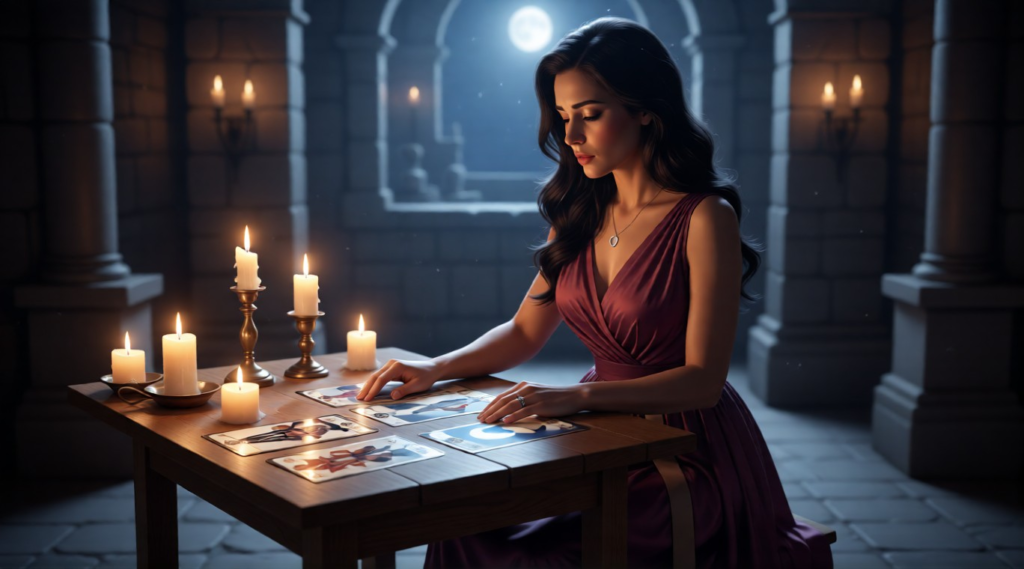
Light a candle if you wish. Sit quietly. Look at the image.
Then ask yourself what it might be showing you.
What needs to end?
What chains are you ready to question?
What structure can no longer hold you?
What path are you willing to walk even without knowing exactly where it leads?
The card may not give you an answer.
Sometimes its purpose is simply to give you the courage to ask the question.