
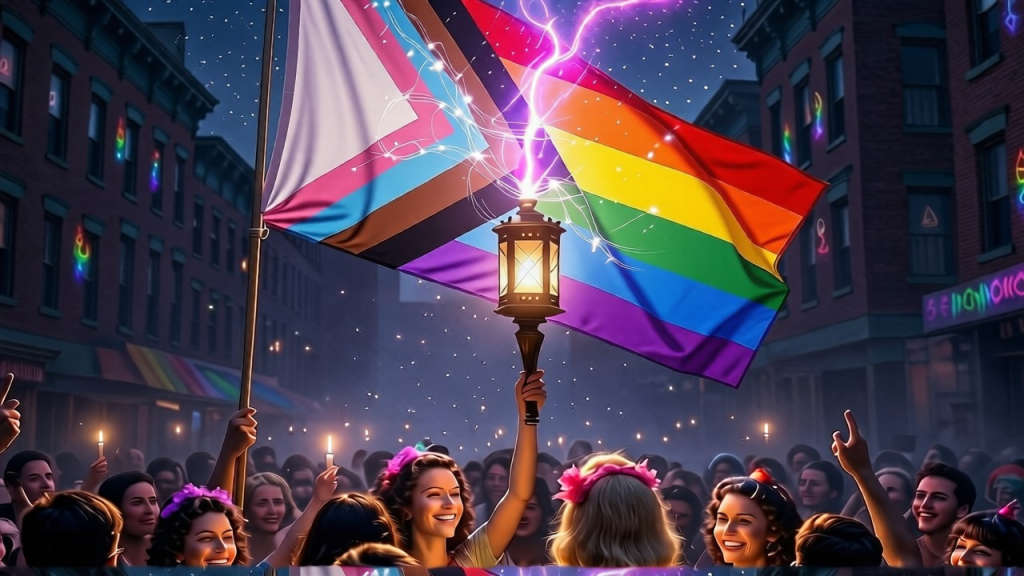
Every June, rainbow flags appear in storefront windows, music fills city streets, and corporations suddenly discover that queer people exist. Beneath the glitter, however, beneath the parades and celebration, there is something older and more sacred moving through Pride Month. Pride did not begin as marketing. It began as resistance. It began as survival. In many ways, it began as mythic fire.
When I think about Pride spiritually, I often think about Stonewall—not simply as a historical event, but as a kind of modern sacred mythology for queer people. Not mythology in the sense of fiction, but mythology in the deeper human sense: a story that shapes identity, transmits values, and explains who we are to one another. Stonewall functions almost like a creation story for modern queer liberation. It is one of the great threshold moments where silence broke open and something new emerged into the world.
In June of 1969, queer people fought back against police harassment at the Stonewall Inn in New York City. Drag queens, transgender women, street kids, butch lesbians, gay men, and countless others who lived at the margins stood against humiliation and violence. These were not polished activists with institutional power. Many were poor. Many were rejected by their families. Some were homeless. Some survived through sex work. They were people the world considered disposable.
And yet they became sacred witnesses to a new future.
What moves me most about Stonewall is not only the rebellion itself, but the spiritual truth underneath it: there comes a point when survival transforms into refusal. Refusal to disappear. Refusal to apologize. Refusal to accept shame as destiny. That moment of collective refusal carries enormous spiritual power.
As a transgender woman living in the United States today, I feel the echoes of Stonewall deeply. We are once again living through a time when queer and trans existence is treated as political controversy rather than human reality. Laws target our healthcare, our visibility, our books, our lives. Anti-trans rhetoric floods media and politics, designed to exhaust us and make us afraid of our own authenticity. In moments like this, Pride becomes more than celebration—it becomes ritual resistance.
To exist openly as transgender today is, in many ways, a sacred act. To choose joy when the world profits from your despair is sacred. To love openly when others preach shame is sacred. To gather together, to dance, to march, to laugh, to kiss, to survive—these things become ceremonies of collective healing.
This is why I think of Stonewall in mythic terms. Mythology teaches people how to endure darkness and transform it into meaning. Stonewall reminds queer people that we come from survivors, rebels, visionaries, and dreamers. It reminds us that liberation did not descend gently from above. It was fought for by people who were exhausted, frightened, and imperfect—and who chose courage anyway.
In Faerie spirituality, thresholds hold special power. Doorways, crossroads, twilight, transformation—these liminal places are where magic happens. Stonewall feels like one of those thresholds in history. Before it, queer people were expected to remain hidden and silent. After it, something irreversible had begun. The old world had cracked. Through that crack came visibility, community, and the possibility of liberation.
I sometimes imagine the energy of Stonewall like a sacred fire passed hand to hand across generations. The people there may not have used words like “faerie energy” or “sacred ritual,” but I believe they understood something profoundly spiritual: there is power in standing fully in your truth, especially when the world demands your invisibility.
Pride Month is often misunderstood as mere celebration, but celebration itself can be holy. Throughout human history, oppressed people have gathered in festivals, dances, songs, and rituals not because suffering vanished, but because joy helped them survive it. Queer joy is ancient medicine. Pride carries that medicine forward.
For me, Pride is not only political—it is spiritual remembrance. I remember those who came before us. I remember the transgender women, drag queens, and queer outcasts who stood in defiance so future generations could breathe more freely. I remember that our existence has always been treated as dangerous precisely because authenticity threatens systems built on fear and conformity.
And I remember that being visible is its own form of magic.
When I walk openly through the world as myself, I carry those histories with me. Every trans woman who chooses softness instead of shame, every queer person who chooses love instead of hiding, every young person who dares to imagine a future for themselves—they all continue the sacred work that Stonewall ignited.
Pride is not about perfection. It is about presence. It is about saying: We are here. We have always been here. And we are not going back into the shadows.
That is why I see Pride as sacred. It is not merely a party or a protest. It is a living ritual of memory, survival, transformation, and joy. It is the annual rekindling of a fire first lit by those who refused to disappear.
And like all sacred fires, it still burns.